WELCOME TO MIDDLEBURY UNITED METHODIST CHURCH
OUR STORY
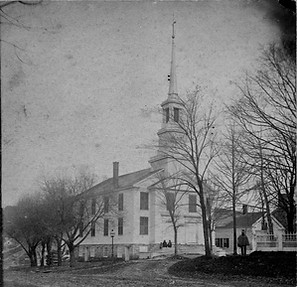
Late in the cold afternoon of January 30, 1892, fire broke out in our church. The wooden structure was quickly fully engulfed. A bucket brigade and the town's horse-drawn pump were no match for the inferno, and the building was totally destroyed. Our congregation was stricken by the loss. With little insurance coverage, financing the reconstruction seemed impossible.
They struggled with their doubts and feelings that somehow they had done something wrong. They worried that their membership would not survive. Yet through prayer and study they pulled themselves right, realizing the gift God had given them in the revelation that faith can move mountains.
Resolved to build a church that would last through the generations, they were committed to preserving this community of faith in our neighborhood.
"Best of all, God is with us."
Our origins root directly to John Wesley. We've been in existence since the beginning of Methodism. John Wesley was trained at Oxford and ordained in the Anglican Church. At 28, he and his brother resolved to conduct their lives by rule and method--seeking to achieve a holy life by means of highly disciplined self-denial and austerity. It was this "method" of practicing one's religion that led to the nickname "Methodist."
Ironically, this focus on controlled living by strict rules led to a liberating salvation justified by grace through faith. That is to say, Wesley was convinced that if a person was converted to the joy of Christ's love, and acted with self sacrifice to the Lord, they could believe and know in their hearts that their sins were forgiven. Salvation was theirs, and indeed, was the choice of every person.

Grand Mountains
In Middlebury, the first record of Methodist preaching in the area was in 1798 with the founding of the Vergennes Circuit. It is believed, however that the faith was being practiced well before this date. Ministers preached day after day, riding horseback between towns.
Wesley's thinking was clear and radical. Methodists were blazing new ground, and for this, our forbears suffered. Rev. Ebenezer Washburn was on the Vergennes Circuit in 1801. Writing of his experiences as a circuit rider: "I have had stones and snow-balls cast at me in volleys. I have had great dogs sent after me, to frighten my horse, as I was peacefully passing through small villages."
Wesley personally sent Thomas Coke and Francis Asbury to take charge of the growing American church in 1784. Asbury, as the first American Bishop, was urged to come to Middlebury to sanction the construction of our first church. In 1810, he wrote in his journal that they crossed the "Grand Mountains" and came to Middlebury. "We have a respectable little society [here], but no Chapel. I preached in the Court House. I have moved a subscription to build a house 64 by 44 on the lot fronting the college. The lord will visit Middlebury."
Within three years a Chapel was up but was quickly too small, requiring a larger replacement. With the Great Revival in the early Nineteenth century, we built an imposing wooden structure on our current site in 1837.

Being a Methodist: The priesthood of all believers
Ardent enthusiasm coupled with open-minded practical thinking is a powerful combination of forces that has guided us through two hundred years of tumultuous social and political upheaval. The Methodist hot house has germinated profoundly important ideas and given individuals the tools to carry those ideas into action.
For example, John Raleigh Mott, a Methodist Layman active in New York, started the World Council of Churches, spawning the most expansive ecumenical movement in the history of Christianity. For this he won the Nobel Peace Prize in 1946.
The Chautuaqua Institution, in Western New York, was started as a summer training institute for Sunday school teachers. Today the Institution thrives as an unparalleled center for culture, arts, and education.
The founders of the NAACP included the powerful Methodist Bishop Alexander Walters. Women have preached since the beginning of our church; in the US, they were officially sanctioned as local preachers in 1924. Methodists introduced the first Hymnal in the United States with the founding of our own publishing company. The idea of social justice came into sharp focus in reaction to the Pullman Car strike during the Industrial Revolution. From the pulpit, preachers denounced the corporate policies that threatened workers rights. We formally adopted the Social Creed in 1908. Today it reads in part: "We believe in the right and duty of persons to work for the glory of God and the good of themselves and others and in the protection of their welfare in so doing; in the rights to property as a trust from God, collective bargaining, and responsible consumption; and in the elimination of economic and social distress."

We have one of the largest networks of hospitals in the world.
We've started many colleges, including Duke, Syracuse, American, and Boston Universities.
Five Presidents were Methodists: James Polk, Ulysses S. Grant, Rutherford Hayes, William McKinley, and George W. Bush.
Today we are the third largest denomination in the United States.
Theodore Roosevelt said about Methodism: "Its history is indissolubly interwoven with the history of our country.... Its essential democracy, its fiery and restless energy of spirit and the wide play that it gave to individual initiative... make it particularly congenial to a hardy and virile folk."

"On this rock I will build my church"
When our church burned, a decision was made to hire a renowned architect to design a building worthy of our forward thinking, committed congregation. The present building, which was constructed in 1892, is a late-Victorian, Shingle Style, Romanesque church designed by the Brooklyn, NY firm of Valk & Son with later adaptations and modifications by local architect Clinton Smith. The exterior is clad in rusticated stone veneer on the lower half of the first story and brick veneer on the remainder of the first story. Slate shingles clad the exterior in the gable ends in the upper half story. The most prominent feature of the façade is the 4-story, square tower topped with an octagonal belvedere-style cupola which houses a bell originally belonging to the USS Mount Katmai. The other prominent feature of the façade is a large pointed-arch window with multi-light, stained glass with geometric tracery set into a large gable facing Seminary Street. The church is now listed on the National Register of Historic Buildings.
Inside the main entrance facing North Pleasant Street, the visitor enters a foyer under the belltower, leading to the sanctuary and an adjacent spacious fellowship hall and kitchen. The sanctuary floor slopes downwards from the fellowship hall to the chancel with its curved altar rail. The soaring ceiling and curved wooden pews create an auditorium-like effect as the eye is drawn to the 1893 George Sherburn Hutchings pipe organ at the north end, with a huge wooden cross suspended in front of it. (For more information about MUMC's Tracker organ, click HERE.) The sanctuary also houses a parlor organ and an electronic keyboard. Excellent acoustics enhance the worship service.
A staircase leads from the foyer to the basement level of the building, which has entrances from the parking lot on the east side and a driveway on the north side. It holds a large meeting room, mini-kitchenette, a nursery for young children, and several small multi-purpose rooms as well as a utility room. Both levels of the building have accessible entrances and bathrooms.